Published pattern · 76
A bounded passage with a route to wider context
Choose the reading unit by the task while keeping its boundaries and context visible.
Published · Editorially reviewed 5 October 2026
Evidence: Research-informed design proposal. Publication is not user validation.
Concrete takeaway
Present the full chosen passage, its reference and edition.
Who this helps—and where it can get in the way
Useful when
A reader wants a coherent passage for reflection, with the freedom to continue.
Potential benefit
A visible beginning and end can make the task understandable without substituting a summary for Scripture.
Cost and drawback
Editorial boundaries can obscure an argument or imply a preferred interpretation. A short unit may interrupt someone who wants sustained reading.
Different circumstances
A newcomer may value a bounded starting point; someone tracing an argument may need continuous text. The same reader can need both at different moments.
A question for discernment
Who chose this boundary, and can the reader inspect and change it?
Try it with people
Ask readers to identify the passage boundaries, open preceding context and return. Observe orientation separately from comprehension.
Editorial review: 5 October 2026. Benefits and risks here are contextual design judgments to investigate, not measured outcomes.
Choose an approach
These are editorial decision conditions to validate. Some alternatives are successive states or can be combined; they are not always exclusive choices.
| Alternative | Use when | Tradeoff or requirement |
|---|---|---|
| A · Focused passage | A bounded devotional or discussion task is chosen | Context routes and editorial boundaries remain explicit |
| B · Continuous reading | The person wants sustained reading | Restore selection without repeatedly recentering |
| C · Shared practice passage | Several practices share a passage | Offer mode changes without forcing completion or disclosure |
The problem
A chapter can be too broad for one reflection; an isolated verse can omit the argument. A focused page can also hide neighbouring text or imply that editorial boundaries are definitive.
The pattern
Present the full chosen passage, its reference and edition. Explain editorial headings and passage boundaries. Offer preceding and following context and continuous reading without losing the original selection.
Compare the alternatives
Choose the reading unit by the task while keeping its boundaries and context visible.
A · Focused passage
A coherent unit for a bounded encounter.
B · Continuous reading
Sustained reading with a recoverable focus.
C · Shared practice passage
Several voluntary modes retain one source.
Original wireframe proposals · No live controls · Grey rows represent schematic text, not loading states · Labelled placeholders are not Scripture quotations
Download this wireframe as SVGFailure modes
Clipping a passage without notice; treating one boundary as universal across editions; replacing source text with an AI summary; making context available only through chat.
Bible and faith considerations
A pericope is an editorially bounded unit, not a universal measure of an ideal session. Short reading and sustained reading both remain legitimate.
What to validate
Compare focused and continuous layouts for orientation, comprehension, voluntary rereading and context access. Include poetry and passages crossing chapter boundaries.
Research-informed design proposal. These visual alternatives have not been tested with users in this atlas. Source findings, documented behaviour and this proposed adaptation are different kinds of evidence.
Sources and adaptation
This card is an original design synthesis. The following sources inform its content distinctions, interaction approach or review requirements; they do not validate the whole pattern.
- The Habits and Hermeneutics of Digital Bible ReadersPublished abstract reviewed; author discussion reviewed separately · Population and study context limit transfer. Abstract-level review does not establish causal effects or a preferred passage length.
- How Digital Apps Are Changing How We Read the BibleAuthor’s public account reviewed · An author summary of research, not an independent replication; it does not test pericope pages.
- Aperto passage-centred design directionLocal passage model reviewed; design rationale documented as a hypothesis · Neither this architecture nor the product direction establishes a measured improvement in comprehension or formation. AI podcast behaviour was not independently exercised.
- Scripture structure documentationRelevant structure and marker references reviewed · A format is not a complete model of app behaviour, annotations or formation.
- Digital Spiritual Formation: The Aperto Vision · selected Draft 4 reviewSelected sections on reading, engagement, multimodal and communal formation, incentives and honest assessment reviewed 5 October 2026 · Not an effectiveness study. Full bibliography and manuscript are not published or comprehensively reviewed here.
Common scenarios and flows
- Prepare teaching with accountable evidence — Build an explanation that another person can inspect, without outsourcing interpretive responsibility.
- Move from a focused passage to sustained reading — Support a bounded encounter without trapping the reader inside an excerpt.
Put this pattern in context
- Help people read with context — What does this person need to understand or find?
Examples in use
Attributed app evidence with dates and review limits. A screenshot illustrates an implementation; it does not establish that the proposal works for every audience.
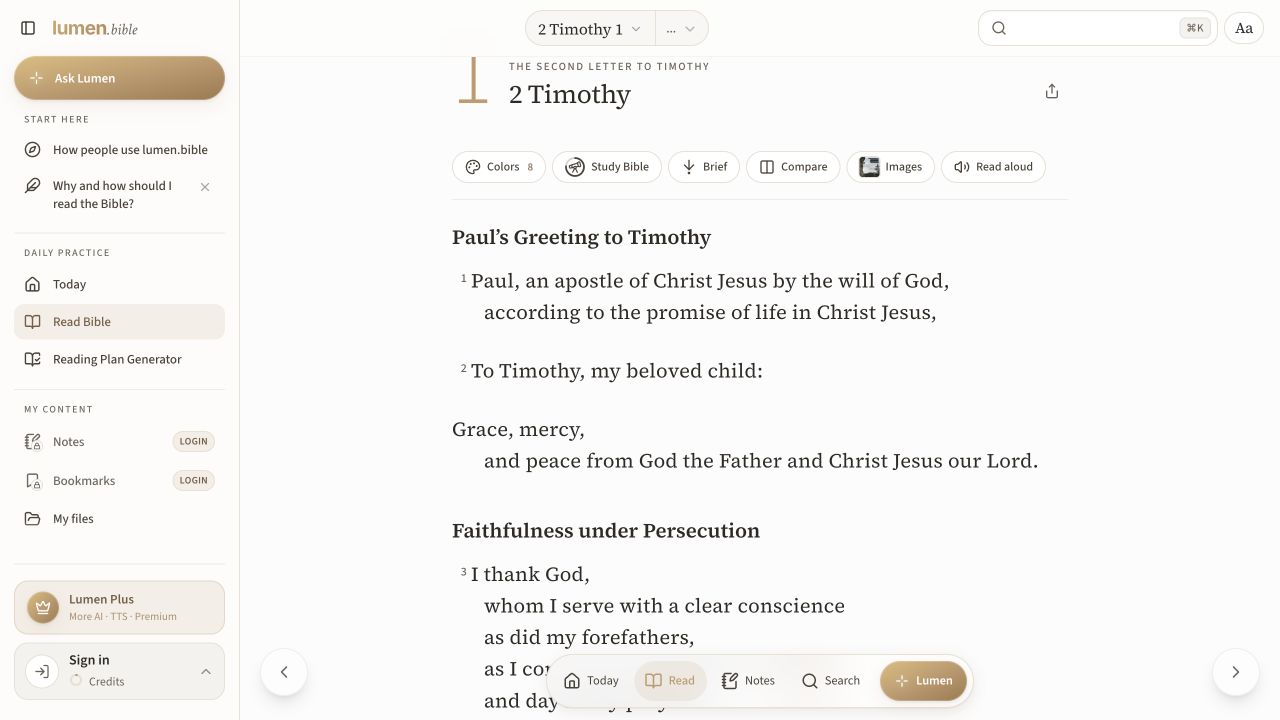
Formation research decision
Use a bounded passage for a focused reflection, with adjacent text and chapter access. Compare understanding and orientation against continuous reading; a shorter page is not an established formation intervention.
Design principles in this decision
Editorial application of Missional by Design. These values frame review questions; they do not validate a pattern’s effectiveness.
- Rootedness — Which source and tradition inform this experience, and what meaning or context might this adaptation lose?
- Fruit — What outcome matters for this task, what can be observed responsibly, and what remains beyond the evidence?
Compare alternatives using the task and evidence above. Record competing needs instead of treating a principle as an automatic verdict.