Pattern 12
The reader controls the scroll
Let new content arrive without moving text someone is already reading.
Concrete takeaway
Follow new content only while the reader remains at the live end.
Choose an approach
These are editorial decision conditions to validate. Some alternatives are successive states or can be combined; they are not always exclusive choices.
| Alternative | Use when | Tradeoff or requirement |
|---|---|---|
| A · At the live end | The user remains at the live end | Following output must stop after manual exploration |
| B · Reading earlier text | The user is reading earlier content | New output needs an unobtrusive return-to-latest action |
| C · Return from a source | The user returns from an external source | Restore the prior anchor rather than forcing the latest message |
The problem
Streaming, card expansion and late-arriving evidence can push the current paragraph out of view.
The pattern
Follow new content only while the reader remains at the live end. After manual scrolling, preserve position and offer a return-to-latest control. Anchor expansions and returning from external content to the original reading place.
Compare the alternatives
Let new content arrive without moving text someone is already reading.
A · At the live end
Following is appropriate while the reader stays at the latest output.
B · Reading earlier text
New output does not take over the viewport.
C · Return from a source
Recover the same passage and conversation position.
Original wireframe proposals · No live controls · Grey rows represent schematic text, not loading states · Labelled placeholders are not Scripture quotations
Download this wireframe as SVGFailure modes
Forced scrolling after every token; citations causing surprise jumps; collapsing content above the current viewport without retaining an anchor.
What to validate
During a long stream, scroll upward, expand a card and open a source. Verify that the reader keeps control and can deliberately return to the latest answer.
Research-informed design proposal. These visual alternatives have not been tested with users in this atlas. Source findings, documented behaviour and this proposed adaptation are different kinds of evidence.
Sources and adaptation
This card is an original design synthesis. The following sources inform its content distinctions, interaction approach or review requirements; they do not validate the whole pattern.
- AI Chatbots Design GuidelinesPublished UX guidance reviewed · General chatbot research, not validation of these Bible-app patterns.
- Interrupt and ResumePattern detail reviewed · Backend recovery must match the UI promise.
- Pattern CatalogueCatalogue entries and descriptions reviewed · A broad observational design catalogue rather than an exclusively AI or faith resource.
Common scenarios and flows
- Read a long passage from a conversation — Inspect complete Scripture without letting an embed take over the dialogue.
- Move from a focused passage to sustained reading — Support a bounded encounter without trapping the reader inside an excerpt.
Examples in use
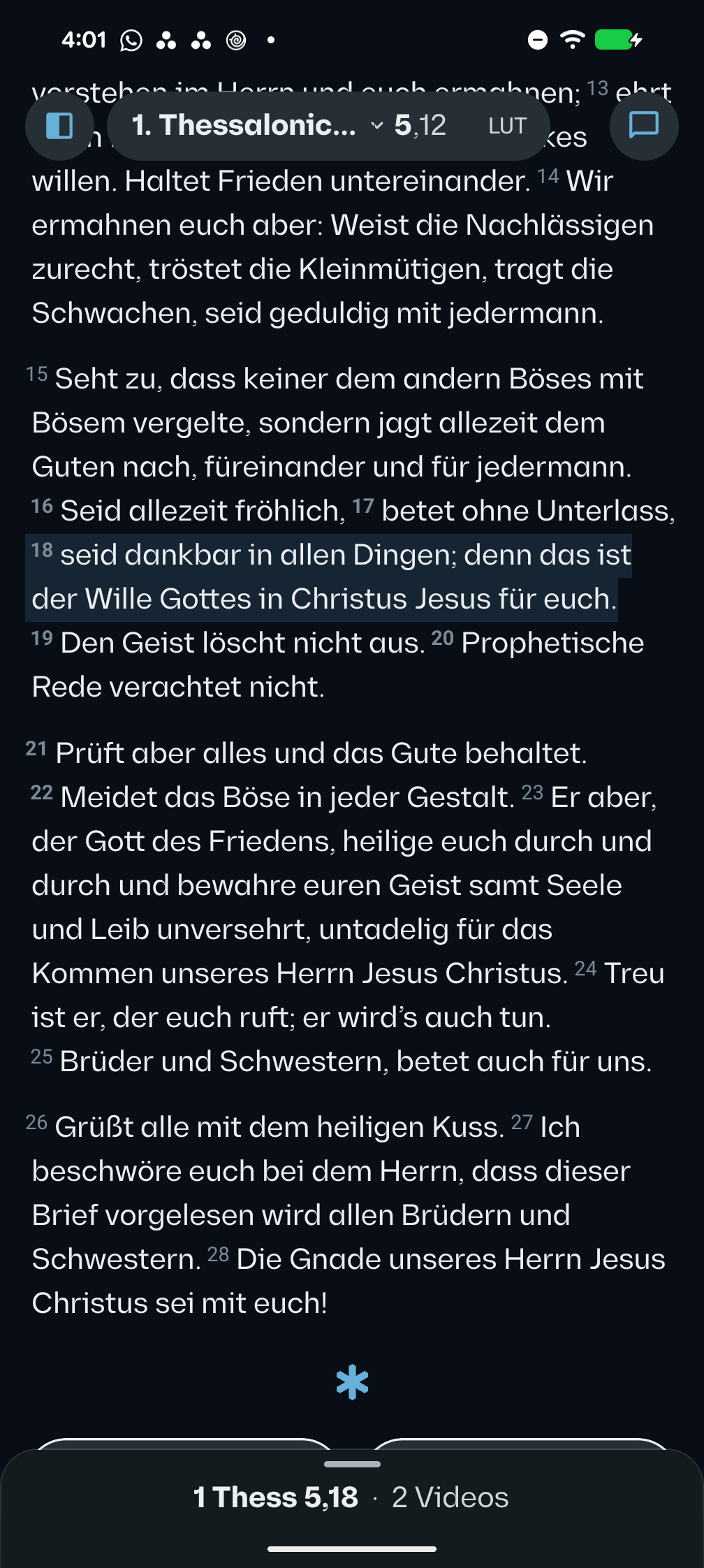
Attributed app evidence with dates and review limits. A screenshot illustrates an implementation; it does not establish that the proposal works for every audience.
Design principles in this decision
Editorial application of Missional by Design. These values frame review questions; they do not validate a pattern’s effectiveness.
- Fruit — What outcome matters for this task, what can be observed responsibly, and what remains beyond the evidence?
Compare alternatives using the task and evidence above. Record competing needs instead of treating a principle as an automatic verdict.