Pattern 52
Chat contains source objects, not just bubbles
Give verses, passages, links and media recognisable identity and appropriate actions.
Concrete takeaway
Use an inline reference link for a brief citation, a bounded verse or passage card for text worth inspecting, and a full reader for sustained reading.
Choose an approach
These are editorial decision conditions to validate. Some alternatives are successive states or can be combined; they are not always exclusive choices.
| Alternative | Use when | Tradeoff or requirement |
|---|---|---|
| A · Reference and verse | A citation or short verse supports an answer | A verse card still needs surrounding context |
| B · External resource | An external article is the evidence object | An unavailable preview must retain a usable link |
| C · Media object | Audio or video is relevant to the question | No autoplay and an accessible alternative are needed |
The problem
A bare link obscures its destination, while a large embed can crowd out the answer. Generated explanation can be mistaken for the text inside a Scripture card.
The pattern
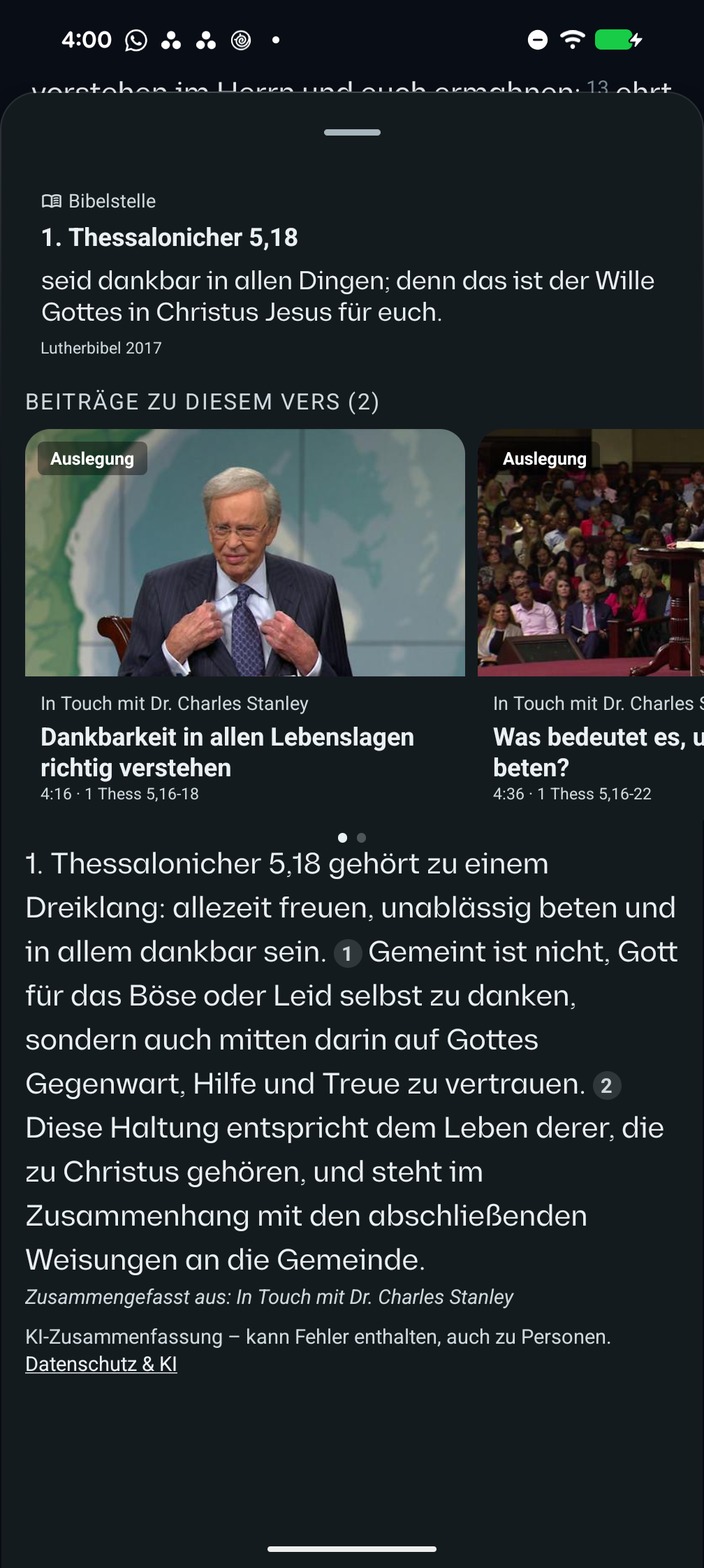
Use an inline reference link for a brief citation, a bounded verse or passage card for text worth inspecting, and a full reader for sustained reading. Name edition, reference, visible range and source. Distinguish external link previews from Scripture and from generated commentary. Video cards identify publisher, duration and captions; audio cards retain passage and narrator. Do not autoplay. Provide plain links or labelled fallbacks when previews, media or permissions fail. Copy and sharing preserve reference and attribution where permitted. Returning from any destination restores conversation position.
Compare the alternatives
Give verses, passages, links and media recognisable identity and appropriate actions.
A · Reference and verse
A lightweight citation can expand into a source-backed object.
B · External resource
A preview identifies its destination and keeps a fallback link.
C · Media object
The user chooses playback; metadata remains visible.
Original wireframe proposals · No live controls · Grey rows represent schematic text, not loading states · Labelled placeholders are not Scripture quotations
Download this wireframe as SVGFailure modes
Autoplaying media; unlabelled generated verse text; enormous previews; a failed embed removing the source link; identical actions for read, play and external navigation.
What to validate
Test a citation, single verse, long passage, external article, video and audio. Include blocked embeds, offline use, captions, large text, copy and return navigation.
Research-informed design proposal. These visual alternatives have not been tested with users in this atlas. Source findings, documented behaviour and this proposed adaptation are different kinds of evidence.
Sources and adaptation
This card is an original design synthesis. The following sources inform its content distinctions, interaction approach or review requirements; they do not validate the whole pattern.
- AI Chatbots Design GuidelinesPublished UX guidance reviewed · General chatbot research, not validation of these Bible-app patterns.
- Progressive DisclosurePattern detail reviewed · The proposed reader transition is a domain adaptation.
- Scripture structure documentationRelevant structure and marker references reviewed · A format is not a complete model of app behaviour, annotations or formation.
- Understanding ReflowOfficial guidance reviewed on 5 October 2026 · Semantic scroll restoration is an original design proposal, not a requirement stated by this criterion.
Common scenarios and flows
- Read a long passage from a conversation — Inspect complete Scripture without letting an embed take over the dialogue.
Examples in use
Attributed app evidence with dates and review limits. A screenshot illustrates an implementation; it does not establish that the proposal works for every audience.
Design principles in this decision
Editorial application of Missional by Design. These values frame review questions; they do not validate a pattern’s effectiveness.
- Hospitality — Who can use this approach in their actual context, and what complete alternative exists for someone who cannot?
Compare alternatives using the task and evidence above. Record competing needs instead of treating a principle as an automatic verdict.