Pattern 49
A reference opens at a deliberate destination
Choose the content scope, landing position and temporary cue separately.
Concrete takeaway
For contextual reading, open the containing chapter and place the first requested verse in view.
Choose an approach
These are editorial decision conditions to validate. Some alternatives are successive states or can be combined; they are not always exclusive choices.
| Alternative | Use when | Tradeoff or requirement |
|---|---|---|
| A · Chapter overview | A chapter overview is the intended destination | Retain the requested reference and a jump action |
| B · Anchored chapter | The person expects the verse in chapter context | A temporary navigation cue must not become a saved mark |
| C · Focused passage | Only the requested range should be previewed | Make the boundary and route to full context explicit |
The problem
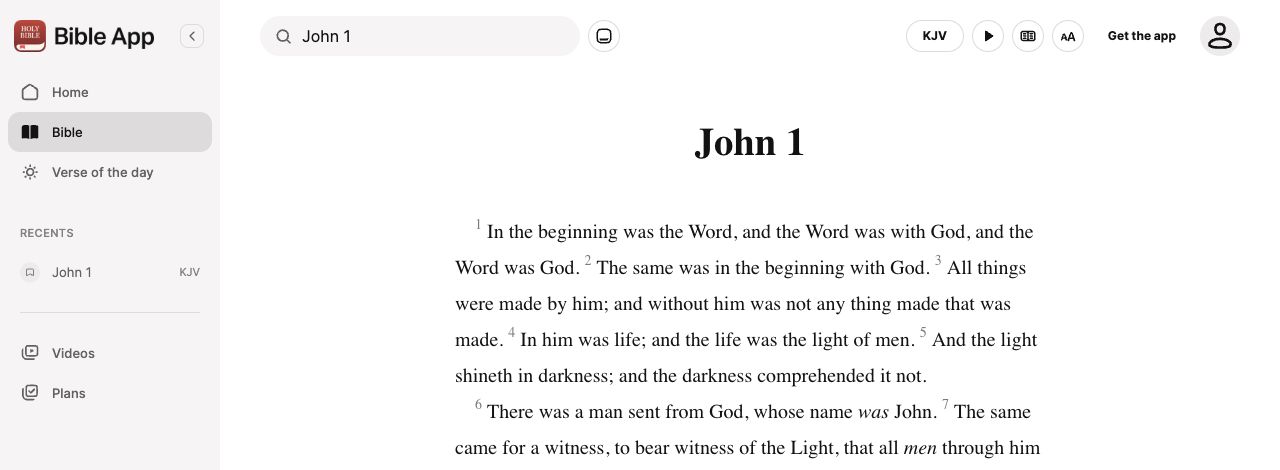
A link to Mark 1:8 can open the chapter at its beginning, land at verse 8, or display only verse 8. These choices support different tasks and should not be accidental.
The pattern
For contextual reading, open the containing chapter and place the first requested verse in view. For a focused preview, show only the verse or requested passage with a Read in context action. A chapter overview may open at the top, but retain the requested reference and provide Jump to verse. Scrolling and highlighting are independent: landing at a verse can use a temporary outline, a labelled margin cue, or no highlight. Mark a requested range rather than only its first verse when helpful. Temporary navigation cues never become saved annotations. Account for headers, players and delayed layout; retain back navigation to the search or chat.
Compare the alternatives
Choose the content scope, landing position and temporary cue separately.
A · Chapter overview
Opening at the top is explicit, with a route to the actual target.
B · Anchored chapter
The chapter remains available; the target is brought into view.
C · Focused passage
Only the requested range appears until the reader chooses context.
Original wireframe proposals · No live controls · Grey rows represent schematic text, not loading states · Labelled placeholders are not Scripture quotations
Download this wireframe as SVGFailure modes
Opening at the chapter top without acknowledging the requested verse; permanently marking a deep-link target; hiding a focused excerpt’s boundaries; losing the origin.
Bible and faith considerations
For cross-chapter ranges, a focused reading surface can span chapter boundaries; a chapter-based view must make continuation explicit.
What to validate
Enter one verse, a range and a cross-chapter passage from search, chat and an external link. Check large text, cold loading, missing content and return navigation.
Research-informed design proposal. These visual alternatives have not been tested with users in this atlas. Source findings, documented behaviour and this proposed adaptation are different kinds of evidence.
Sources and adaptation
This card is an original design synthesis. The following sources inform its content distinctions, interaction approach or review requirements; they do not validate the whole pattern.
- Scripture structure documentationRelevant structure and marker references reviewed · A format is not a complete model of app behaviour, annotations or formation.
- Understanding ReflowOfficial guidance reviewed on 5 October 2026 · Semantic scroll restoration is an original design proposal, not a requirement stated by this criterion.
Common scenarios and flows
- Open a reference and retain context — Reach the intended verse or range without losing the search or conversation.
Examples in use
Attributed app evidence with dates and review limits. A screenshot illustrates an implementation; it does not establish that the proposal works for every audience.
Design principles in this decision
Editorial application of Missional by Design. These values frame review questions; they do not validate a pattern’s effectiveness.
- Hospitality — Who can use this approach in their actual context, and what complete alternative exists for someone who cannot?
Compare alternatives using the task and evidence above. Record competing needs instead of treating a principle as an automatic verdict.