Pattern 44
Intent controls support the prompt
Help people express scope through selections and task choices.
Concrete takeaway
Pair free text with editable context chips and concrete task controls.
Choose an approach
These are editorial decision conditions to validate. Some alternatives are successive states or can be combined; they are not always exclusive choices.
| Alternative | Use when | Tradeoff or requirement |
|---|---|---|
| A · Start from context | A question begins with a passage selection | Context chips should be editable |
| B · Editable scope | The person wants to control source scope | Removing a source must change retrieval transparently |
| C · Confirm an assumption | A material assumption is unresolved | Clarify without turning the task into an interview |
The problem
A blank box makes users responsible for specifying passage, sources, purpose and output format in every prompt.
The pattern
Pair free text with editable context chips and concrete task controls. Use a passage selection, source scope and desired form to express intent. Confirm material assumptions rather than silently inferring them from private data.
Compare the alternatives
Help people express scope through selections and task choices.
A · Start from context
A selected passage reduces prompt-writing effort.
B · Editable scope
The active sources are visible and removable.
C · Confirm an assumption
The product asks only when the choice matters.
Original wireframe proposals · No live controls · Grey rows represent schematic text, not loading states · Labelled placeholders are not Scripture quotations
Download this wireframe as SVGFailure modes
Forcing a complex prompt; invisible source filters; inferring belief or distress from a simple search.
What to validate
Can novice users ask a scoped question and understand what sources and passage will be used? Test removing a context item and correcting an assumption.
Research-informed design proposal. These visual alternatives have not been tested with users in this atlas. Source findings, documented behaviour and this proposed adaptation are different kinds of evidence.
Sources and adaptation
This card is an original design synthesis. The following sources inform its content distinctions, interaction approach or review requirements; they do not validate the whole pattern.
- How can AI UI capture intentArticle reviewed · Avoid turning contextual assistance into hidden inference about belief, health or emotional state.
- AI UX PatternsPublic sample and catalogue framing reviewed · The pattern-composition example is a design reference, not a validation of the proposed faith-specific variants.
- The Shape of AICatalogue and named entries reviewed · The site states CC BY NC SA. This atlas uses original text and original wireframes; it does not reproduce the source illustrations.
- AI UX PlaygroundCatalogue and selected detail pages reviewed · Selected relevant entries reviewed; the entire catalogue was not audited. Its FAQ currently describes 150 patterns in 11 categories.
- GenAI UX Design PatternsPublic framework overview reviewed · The public overview supports this synthesis; linked material and individual examples were not exhaustively audited.
Common scenarios and flows
- Read a long passage from a conversation — Inspect complete Scripture without letting an embed take over the dialogue.
Examples in use
Attributed app evidence with dates and review limits. A screenshot illustrates an implementation; it does not establish that the proposal works for every audience.
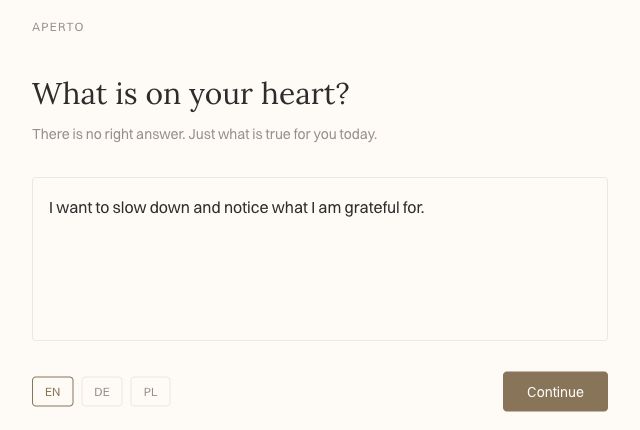 Aperto · Desktop web prototype
An intention before an AI-assisted practice
Local prototype capture · synthetic input · cropped
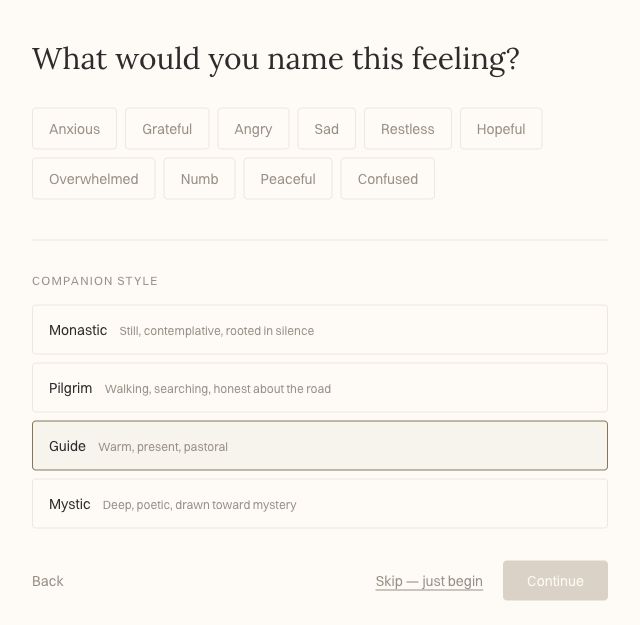 Aperto · Desktop web prototype
Named feelings, companion style and a skip route
Local prototype capture · synthetic session · cropped
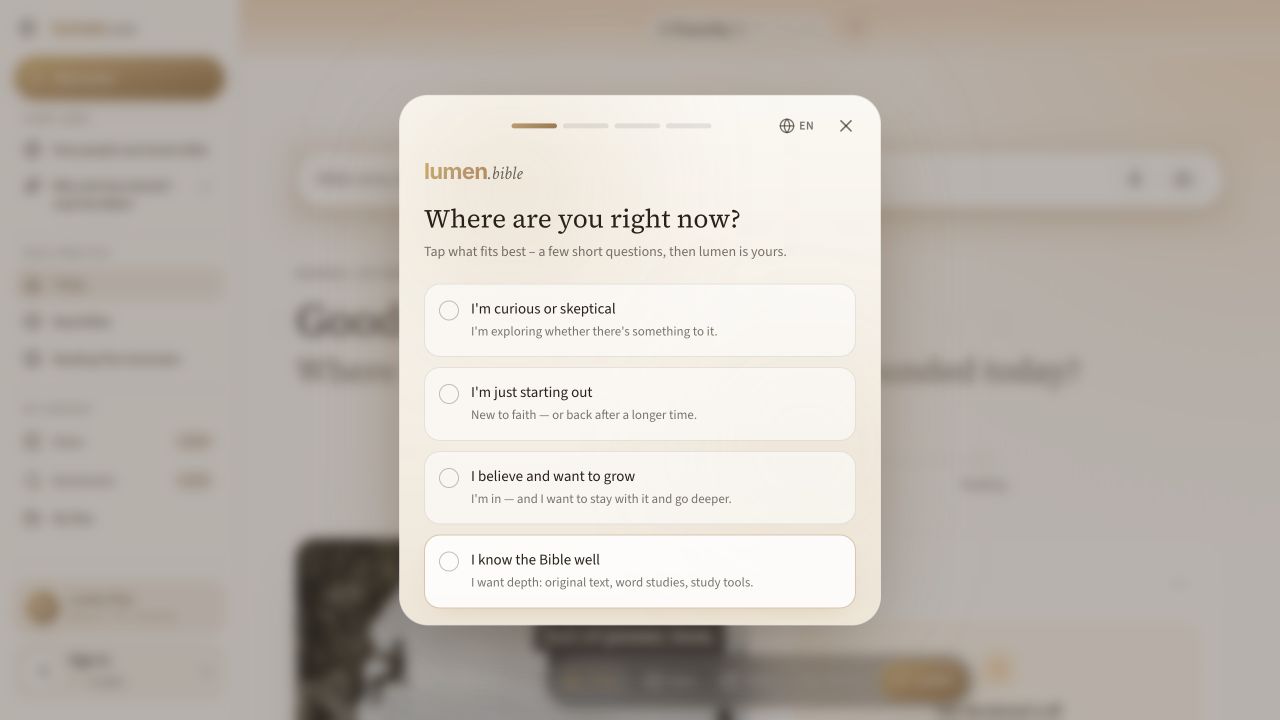 Lumen Bible · Desktop web · English interface
Optional choices about engagement and experience
Direct signed-out web capture
Design principles in this decision
Editorial application of Missional by Design. These values frame review questions; they do not validate a pattern’s effectiveness.
- Reverence — What does this interaction ask of the person, and can they understand, decline, correct or leave it without penalty?
Compare alternatives using the task and evidence above. Record competing needs instead of treating a principle as an automatic verdict.