Pattern 06
Content layers have owners
Separate publisher content, private annotations and internal editorial records.
Concrete takeaway
Give each layer an origin, audience and appropriate rights.
Choose an approach
These are editorial decision conditions to validate. Some alternatives are successive states or can be combined; they are not always exclusive choices.
| Alternative | Use when | Tradeoff or requirement |
|---|---|---|
| A · Publisher material | Content comes from a publisher | Name authorship and edition rights |
| B · Private reflection | The user records a private reflection | Saving requires a clear visibility state |
| C · Editorial review | Imported editorial material needs review | Unsupported or internal data must not leak |
The problem
The word “comment” can describe a study note, internal translation remark, personal reflection or generated interpretation. Showing them as the same object confuses trust and visibility.
The pattern
Give each layer an origin, audience and appropriate rights. Publisher notes and study excursions have provenance. Internal remarks remain internal. Unknown imported structures are reported for review instead of silently discarded.
Compare the alternatives
Separate publisher content, private annotations and internal editorial records.
A · Publisher material
The study layer names its source.
B · Private reflection
Personal work remains a separate layer.
C · Editorial review
Internal records never become reader-facing commentary.
Original wireframe proposals · No live controls · Grey rows represent schematic text, not loading states · Labelled placeholders are not Scripture quotations
Download this wireframe as SVGFailure modes
Publishing internal translation remarks; displaying a personal note as a publisher annotation; losing unsupported content during import without reporting it.
Bible and faith considerations
Import, licence and publishing rules belong in the content pipeline as well as the interface.
What to validate
Use an import corpus containing study notes, sidebars, internal remarks and unknown structures. Check public output, copy, search and audio for unintended disclosure.
Research-informed design proposal. These visual alternatives have not been tested with users in this atlas. Source findings, documented behaviour and this proposed adaptation are different kinds of evidence.
Sources and adaptation
This card is an original design synthesis. The following sources inform its content distinctions, interaction approach or review requirements; they do not validate the whole pattern.
- Extended study footnotesMarker semantics reviewed · A study note is distinct from a personal annotation.
- Study sidebarsMarker semantics reviewed · Sidebar content remains subject to edition rights.
- Internal editorial remarksMarker semantics reviewed · Requires import and publishing controls, not only styling.
- Scripture structure documentationRelevant structure and marker references reviewed · A format is not a complete model of app behaviour, annotations or formation.
Common scenarios and flows
Use this pattern within a complete journey: define the entry, preserve relevant state, plan recovery and name the endpoint. Explore the scenario library.
Examples in use
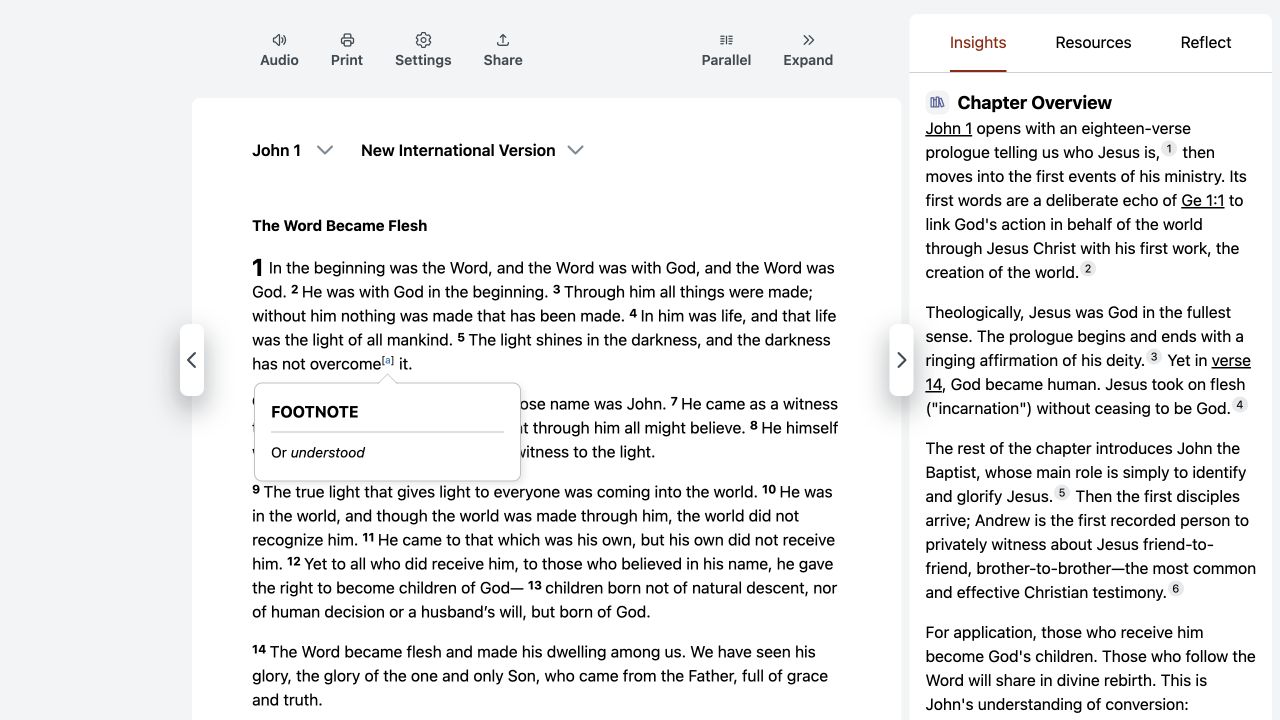
Attributed app evidence with dates and review limits. A screenshot illustrates an implementation; it does not establish that the proposal works for every audience.
Design principles in this decision
Editorial application of Missional by Design. These values frame review questions; they do not validate a pattern’s effectiveness.
- Rootedness — Which source and tradition inform this experience, and what meaning or context might this adaptation lose?
- Costliness — Who pays for this convenience through time, labour, privacy, risk or exclusion, and can the organisation support its promise?
Compare alternatives using the task and evidence above. Record competing needs instead of treating a principle as an automatic verdict.