Pattern 01
Scripture and interpretation stay distinct
Make original text, editorial material and generated explanation recognisable.
Concrete takeaway
Render Scripture from a verified, licensed source.
Choose an approach
These are editorial decision conditions to validate. Some alternatives are successive states or can be combined; they are not always exclusive choices.
| Alternative | Use when | Tradeoff or requirement |
|---|---|---|
| A · Reading view | Sustained passage reading is the main task | Explanation takes a secondary surface |
| B · Conversation card | A verse supports a specific chat answer | Cards can fragment larger context |
| C · Source unavailable | The selected edition cannot be retrieved | Explain the gap without silently substituting text |
The problem
In a reader or chat, a quotation and a fluent explanation can look like one authoritative block. Readers may mistake a paraphrase for their chosen translation.
The pattern
Render Scripture from a verified, licensed source. Keep reference and edition beside the text. Present commentary, paraphrase and AI explanation in separately labelled layers. Copying preserves the distinction and attribution.
Compare the alternatives
Make original text, editorial material and generated explanation recognisable.
A · Reading view
Keep the passage central and explanation secondary.
B · Conversation card
A quotation remains a source object inside a conversation.
C · Source unavailable
An honest missing state preserves the distinction.
Original wireframe proposals · No live controls · Grey rows represent schematic text, not loading states · Labelled placeholders are not Scripture quotations
Download this wireframe as SVGFailure modes
Replacing unavailable source text with model output; modifying a quotation when users choose a shorter explanation; presenting AI text as a publisher note.
Bible and faith considerations
Translation rights and attribution vary by edition. A source citation does not turn interpretation into divine authority.
What to validate
Ask readers to identify the original text, its edition and who wrote each explanation. Test copied and shared output as well as the screen.
Research-informed design proposal. These visual alternatives have not been tested with users in this atlas. Source findings, documented behaviour and this proposed adaptation are different kinds of evidence.
Sources and adaptation
This card is an original design synthesis. The following sources inform its content distinctions, interaction approach or review requirements; they do not validate the whole pattern.
- Scripture structure documentationRelevant structure and marker references reviewed · A format is not a complete model of app behaviour, annotations or formation.
- The Shape of AICatalogue and named entries reviewed · The site states CC BY NC SA. This atlas uses original text and original wireframes; it does not reproduce the source illustrations.
- AI UX PlaygroundCatalogue and selected detail pages reviewed · Selected relevant entries reviewed; the entire catalogue was not audited. Its FAQ currently describes 150 patterns in 11 categories.
Common scenarios and flows
- Read a long passage from a conversation — Inspect complete Scripture without letting an embed take over the dialogue.
- Prepare teaching with accountable evidence — Build an explanation that another person can inspect, without outsourcing interpretive responsibility.
- Listen to an AI overview and inspect a claim — Use explanatory audio while retaining access to the source material and control of the session.
Examples in use
Attributed app evidence with dates and review limits. A screenshot illustrates an implementation; it does not establish that the proposal works for every audience.
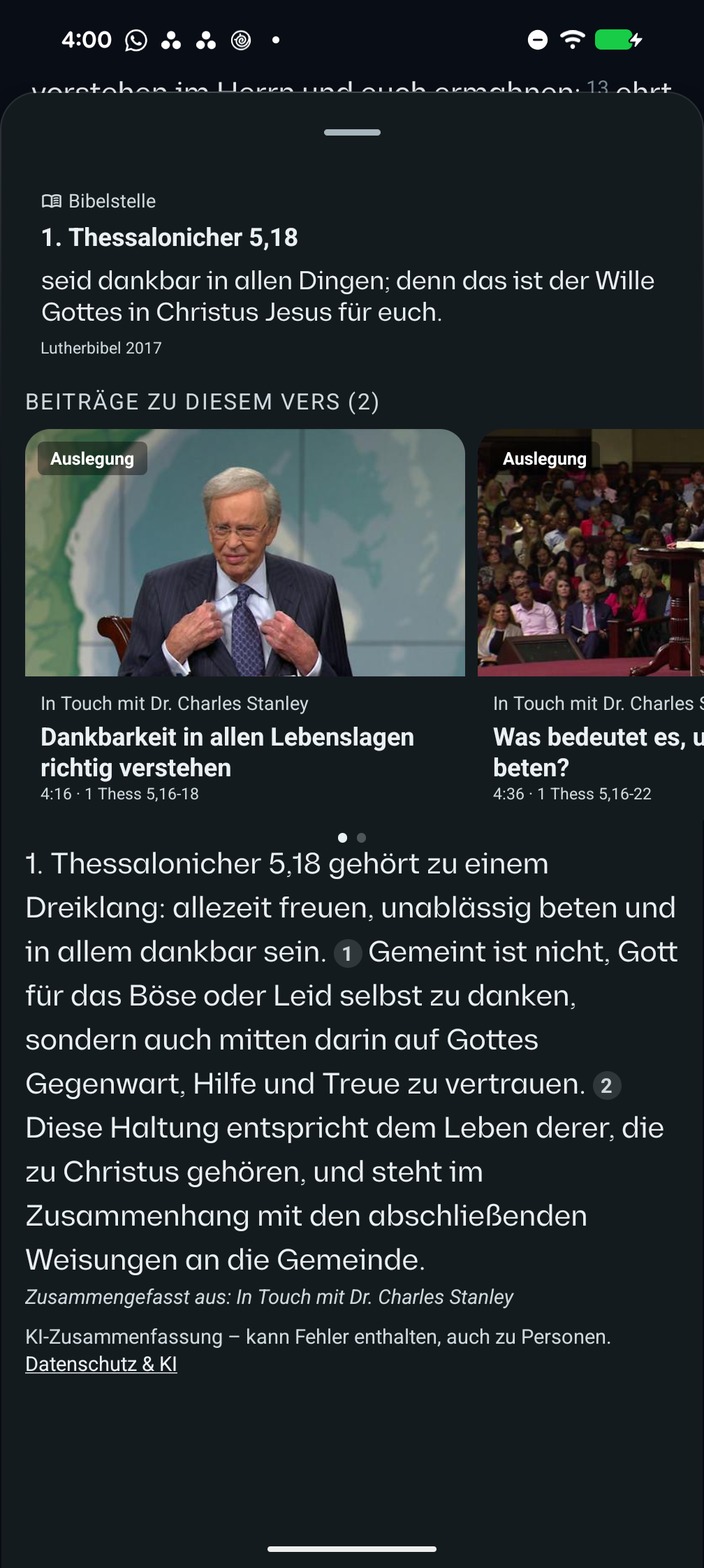
Design principles in this decision
Editorial application of Missional by Design. These values frame review questions; they do not validate a pattern’s effectiveness.
- Rootedness — Which source and tradition inform this experience, and what meaning or context might this adaptation lose?
- Honesty — Could this interface lead a person to infer more authority, certainty, privacy or human support than the service provides?
Compare alternatives using the task and evidence above. Record competing needs instead of treating a principle as an automatic verdict.
Regional applicability
Design review questions · 5 October 2026. These prompts identify possible triggers; they do not classify this pattern or every faith app as a regulated service.
Does generated text, audio or media leave the app? Decide which origin information remains understandable in playback, download and sharing, and which file metadata the applicable role requires.
Start with EU and Germany, then review the relevant market:
- US · Utah: generated-media provenance — Enacted; relevant duties scheduled for 2027
- China — Binding AI-content labelling measures; effective 1 September 2025
- South Korea — AI Basic Act in force; announced enforcement grace period
Use the jurisdiction decision guide to record the trigger, source version and resulting product requirement.