Pattern 79
Identify what AI did, where it matters
Label the actor, action and artifact at the moment they could be misunderstood.
Concrete takeaway
Use plain-language labels beside the relevant feature, speaker or content: AI assistant, explanation generated with AI, AI-assisted prayer draft, or synthetic voice reading a named edition.
Choose an approach
These are editorial decision conditions to validate. Some alternatives are successive states or can be combined; they are not always exclusive choices.
| Alternative | Use when | Tradeoff or requirement |
|---|---|---|
| A · Before an AI action | A person is about to use an AI feature | Name the operation and retain a non-AI route where offered |
| B · Blended content | Generated material sits beside verified text | Labels must identify each layer without labelling the translation as AI |
| C · Actor transition | An interaction changes from AI to human | The change is shown only when a real responder is connected |
The problem
A Bible app mixes verified Scripture, authored commentary, personal notes and generated material. A brand name or sparkle icon may leave readers unsure whether they are reading a translation, a pastor’s words or an AI explanation.
The pattern
Use plain-language labels beside the relevant feature, speaker or content: AI assistant, explanation generated with AI, AI-assisted prayer draft, or synthetic voice reading a named edition. Keep a short visible label and optional details about sources, review and limitations. Retain identity through human handoffs and distinguish retrieval of publisher text from generated interpretation.
Compare the alternatives
Label the actor, action and artifact at the moment they could be misunderstood.
A · Before an AI action
Explain the operation before it begins.
B · Blended content
Keep verified text and generated explanation distinct.
C · Actor transition
Sender identity survives a real human handoff.
Original wireframe proposals · No live controls · Grey rows represent schematic text, not loading states · Labelled placeholders are not Scripture quotations
Download this wireframe as SVGFailure modes
Only disclosing in onboarding or terms; colour-only labels; generic AI tags with no operation; implied clergy credentials; treating a citation or human review badge as proof of correctness; placing an AI tag on verified Scripture because it sits inside an AI response.
Bible and faith considerations
A generated prayer is an editable draft, not divine speech. A synthetic voice reading verified Scripture changes narration provenance without making the edition text AI-authored.
What to validate
Ask readers to identify who or what produced each layer, what AI changed and whether a human actually reviewed it. Test screen readers, first entry through deep links, audio-only use and AI-to-human transitions.
Research-informed design proposal. These visual alternatives have not been tested with users in this atlas. Source findings, documented behaviour and this proposed adaptation are different kinds of evidence.
Sources and adaptation
This card is an original design synthesis. The following sources inform its content distinctions, interaction approach or review requirements; they do not validate the whole pattern.
- The Shape of AICatalogue and named entries reviewed · The site states CC BY NC SA. This atlas uses original text and original wireframes; it does not reproduce the source illustrations.
- DisclosurePattern detail reviewed 5 October 2026 · Industry design guidance; the faith-domain alternatives are original proposals. Source artwork is not reproduced.
- Explainability + TrustChapter reviewed for explanation and trust calibration · General human-AI guidance, not validation of faith apps or a mandate for a particular component.
- Guidelines for Human-AI InteractionOfficial guideline overview reviewed · General guidelines; disclosure alone does not establish accuracy, safety or spiritual benefit.
Common scenarios and flows
- Read a long passage from a conversation — Inspect complete Scripture without letting an embed take over the dialogue.
- Prepare and participate in an AI-assisted practice — Use bounded adaptation while keeping Scripture, authorship and user choice inspectable.
- Receive prayer support without hidden profiling — Choose useful words or silence while retaining ownership of intentions.
- Prepare teaching with accountable evidence — Build an explanation that another person can inspect, without outsourcing interpretive responsibility.
- Listen to an AI overview and inspect a claim — Use explanatory audio while retaining access to the source material and control of the session.
Examples in use
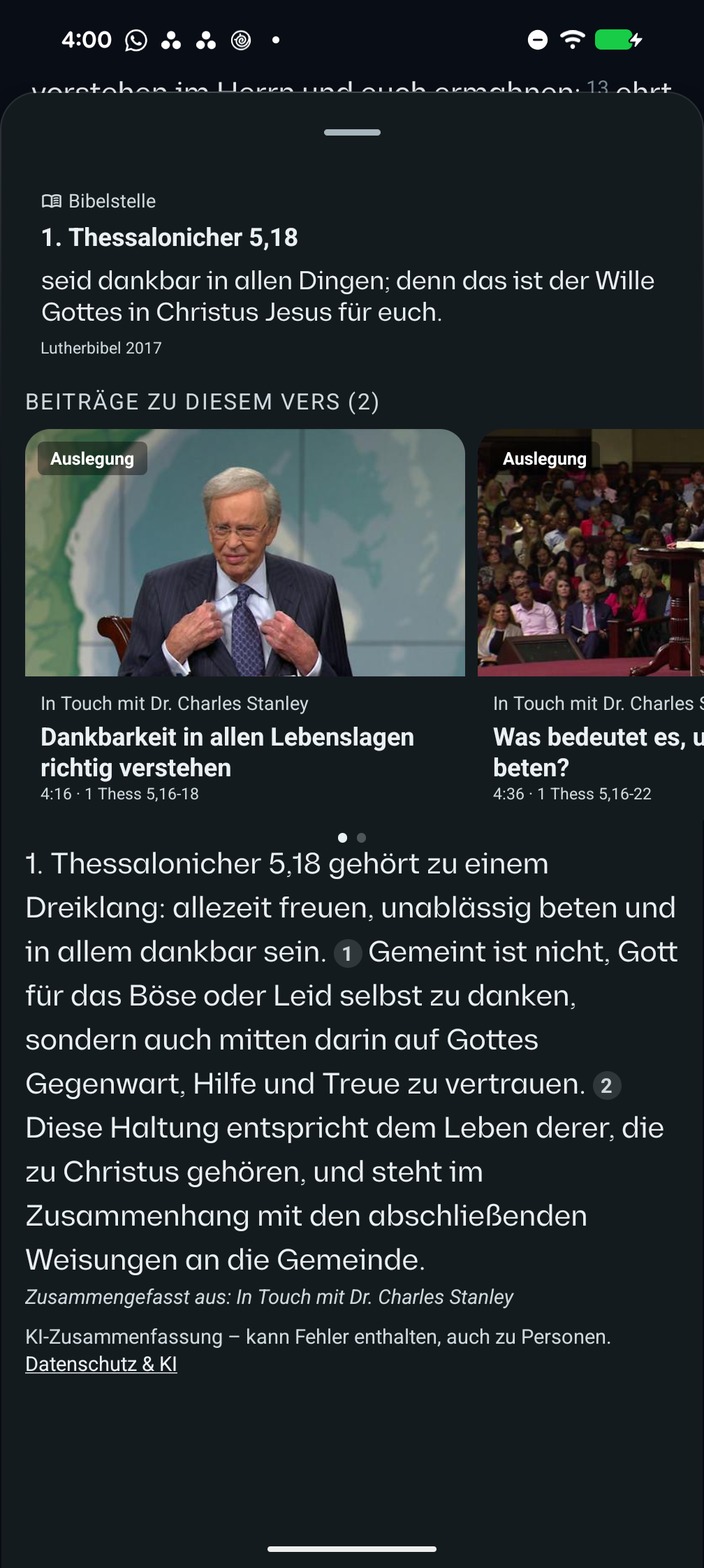
Attributed app evidence with dates and review limits. A screenshot illustrates an implementation; it does not establish that the proposal works for every audience.
Design principles in this decision
Editorial application of Missional by Design. These values frame review questions; they do not validate a pattern’s effectiveness.
- Honesty — Could this interface lead a person to infer more authority, certainty, privacy or human support than the service provides?
Compare alternatives using the task and evidence above. Record competing needs instead of treating a principle as an automatic verdict.
Regional applicability
Design review questions · 5 October 2026. These prompts identify possible triggers; they do not classify this pattern or every faith app as a regulated service.
What does this service actually offer: source assistance, a sustained companion, pastoral support or a clinical service? Review entry, return and recurring notices against the applicable definition.
Start with EU and Germany, then review the relevant market:
- US · California — Enacted AI-specific law
- US · New York — Enacted AI-specific law
- US · Utah: mental-health chatbots — Enacted AI-specific law
- US · Texas — Enacted AI-specific law; effective 1 January 2026
- United Kingdom — Existing law + regulator guidance; policy statement
- Australia — Existing law + regulator guidance; national policy
- China — Binding AI-content labelling measures; effective 1 September 2025
- South Korea — AI Basic Act in force; announced enforcement grace period
Use the jurisdiction decision guide to record the trigger, source version and resulting product requirement.