Pattern 78
Citations open the evidence behind a claim
A citation is a route to supporting material, with source type and limitations visible.
Concrete takeaway
Attach citations to specific claims.
Choose an approach
These are editorial decision conditions to validate. Some alternatives are successive states or can be combined; they are not always exclusive choices.
| Alternative | Use when | Tradeoff or requirement |
|---|---|---|
| A · Claim-linked marker | A claim has identifiable supporting material | A marker must map to a specific claim |
| B · Evidence preview | The person inspects a citation | Evidence context and source type must remain visible |
| C · Evidence gap | Support is missing or inaccessible | Show uncertainty without invented excerpts or timestamps |
The problem
Numbered badges can imply authority without identifying what they support. A Bible reference, sermon interpretation and personal note have different roles and must not become interchangeable evidence.
The pattern
Attach citations to specific claims. Show source title, author, type, edition or publication details and a relevant excerpt or reliable media timestamp. Return to the claim after inspection. Distinguish a quotation, inference, disagreement and a claim with no supporting source.
Compare the alternatives
A citation is a route to supporting material, with source type and limitations visible.
A · Claim-linked marker
The marker belongs to a specific explanation.
B · Evidence preview
Inspect context before accepting a claim.
C · Evidence gap
Show a gap without manufacturing precision.
Original wireframe proposals · No live controls · Grey rows represent schematic text, not loading states · Labelled placeholders are not Scripture quotations
Download this wireframe as SVGFailure modes
Whole-answer citation lists with unclear claim mapping; invented sources or timestamps; counting repeated sources as independent support; inaccessible evidence presented as verified.
Bible and faith considerations
A reference to Scripture locates text; it does not automatically validate an interpretation. Personal notes are user-provided context, not scholarly authority.
What to validate
Can readers identify what a source supports and what it does not? Test contradictory sources, dead links, permission limits, different verse numbering and a citation that does not entail the claim.
Research-informed design proposal. These visual alternatives have not been tested with users in this atlas. Source findings, documented behaviour and this proposed adaptation are different kinds of evidence.
Sources and adaptation
This card is an original design synthesis. The following sources inform its content distinctions, interaction approach or review requirements; they do not validate the whole pattern.
- The Shape of AICatalogue and named entries reviewed · The site states CC BY NC SA. This atlas uses original text and original wireframes; it does not reproduce the source illustrations.
- AI UX PlaygroundCatalogue and selected detail pages reviewed · Selected relevant entries reviewed; the entire catalogue was not audited. Its FAQ currently describes 150 patterns in 11 categories.
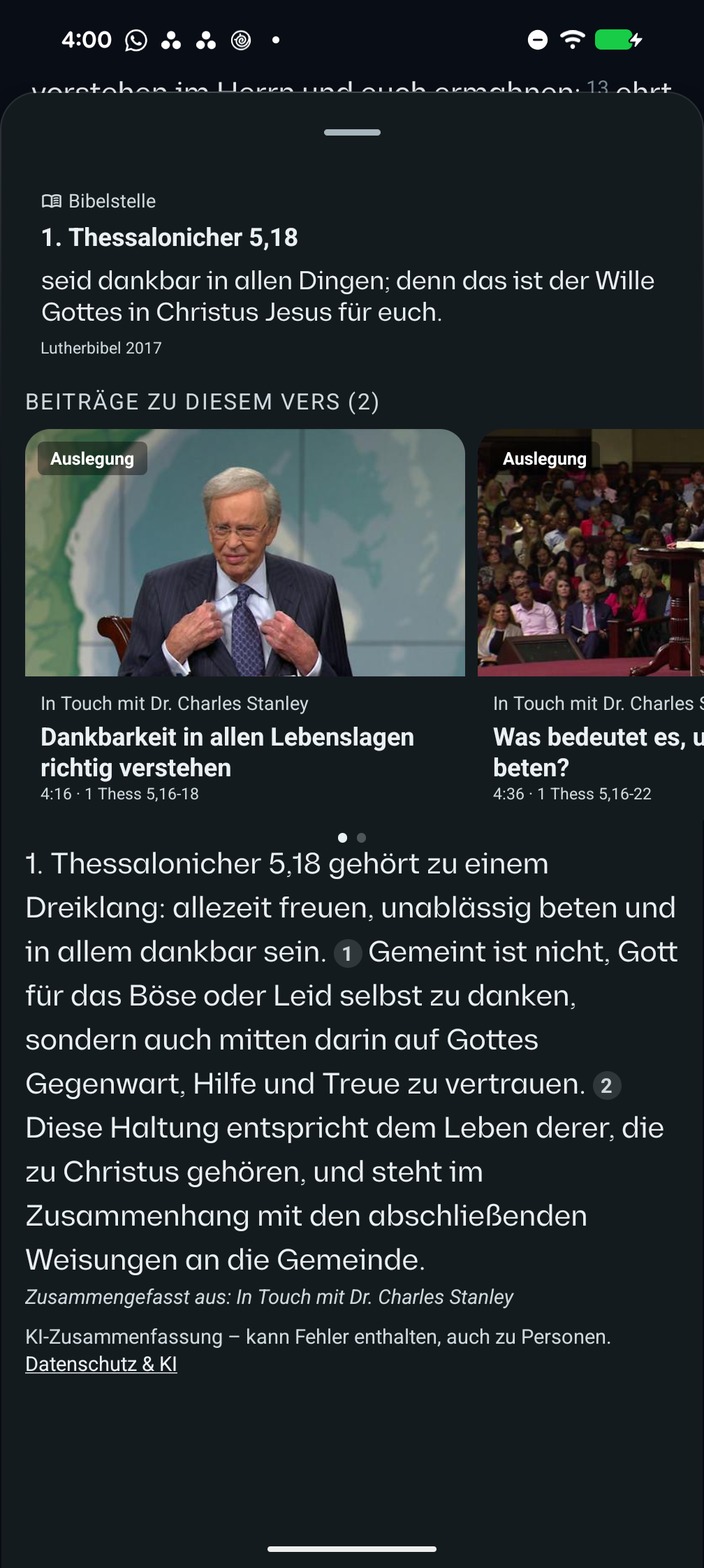
- VSB native prototype: verse sheet and return to readerInstalled Android version 1.0.0, build 1 observed on 5 October 2026 · Prototype evidence; source commit, playback accuracy and generated-summary grounding were not verified.
- Lumen Bible: engagement choices and readerSigned-out desktop web observed and captured 5 October 2026 · AI services were not enabled. No AI correctness, privacy compliance, health benefit or mobile usability claim was evaluated.
Common scenarios and flows
- Prepare teaching with accountable evidence — Build an explanation that another person can inspect, without outsourcing interpretive responsibility.
- Listen to an AI overview and inspect a claim — Use explanatory audio while retaining access to the source material and control of the session.
Examples in use
Attributed app evidence with dates and review limits. A screenshot illustrates an implementation; it does not establish that the proposal works for every audience.
Design principles in this decision
Editorial application of Missional by Design. These values frame review questions; they do not validate a pattern’s effectiveness.
- Honesty — Could this interface lead a person to infer more authority, certainty, privacy or human support than the service provides?
- Costliness — Who pays for this convenience through time, labour, privacy, risk or exclusion, and can the organisation support its promise?
Compare alternatives using the task and evidence above. Record competing needs instead of treating a principle as an automatic verdict.