Pattern 55
Group editions around a shared verse
Use repeated verse groups when matching corresponding passages matters more than continuous reading.
Concrete takeaway
Group the chosen editions beneath a common reference.
Choose an approach
These are editorial decision conditions to validate. Some alternatives are successive states or can be combined; they are not always exclusive choices.
| Alternative | Use when | Tradeoff or requirement |
|---|---|---|
| A · Mobile: stacked editions | Matching verses is the main mobile task | Interleaving can fragment continuous reading |
| B · Large screen: grouped columns | Width supports edition columns within each verse group | Equal verse numbers do not prove word alignment |
| C · Continuous alternative | The reader wants the argument or poem as a whole | Offer a direct return to targeted comparison |
The problem
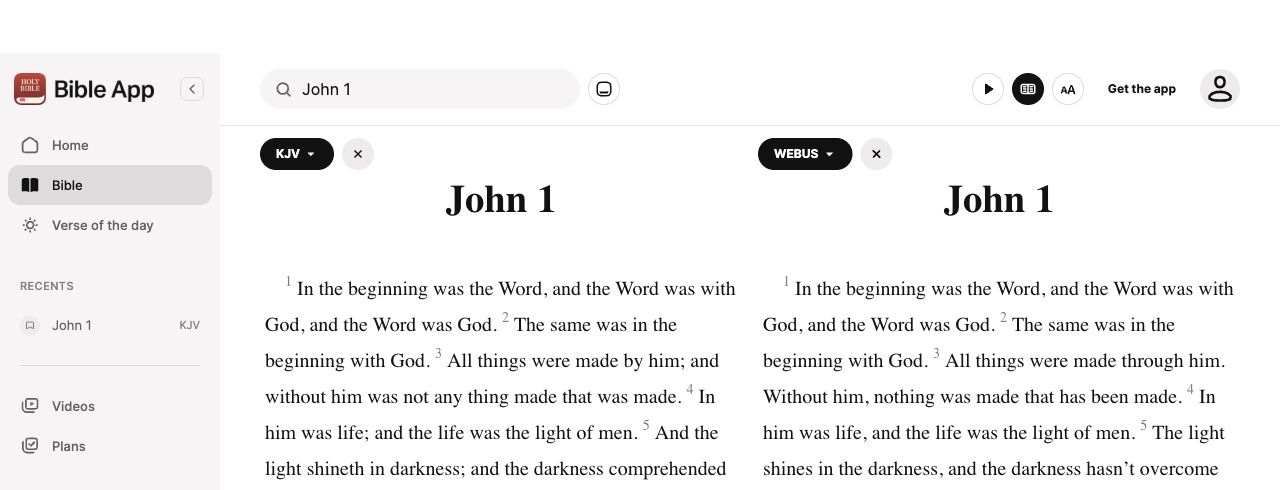
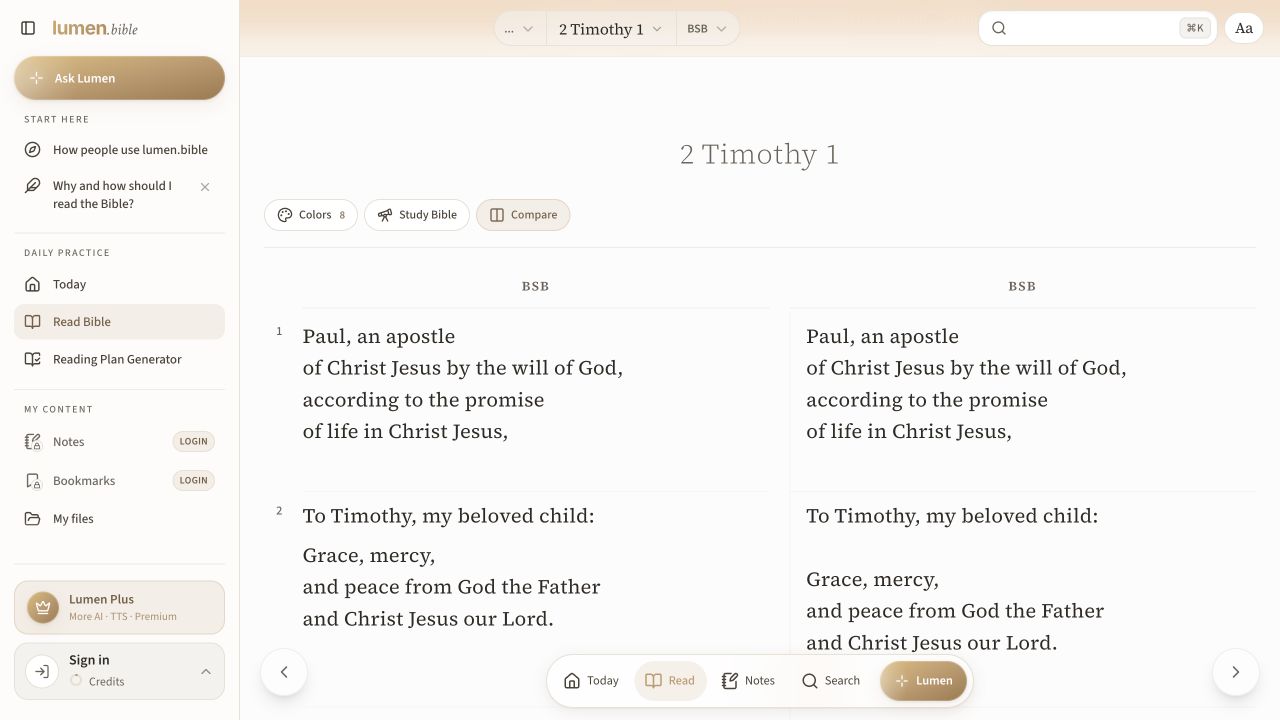
Independent columns make a short comparison difficult when translation lengths differ. Interleaving every verse can fragment a sustained reading task.
The pattern
Group the chosen editions beneath a common reference. Repeat edition labels and preserve wording, paragraph structure and edition-specific numbering. Offer stacked edition blocks for narrow screens and columns inside each verse group where width permits. A continuous-text alternative supports reading an argument or poem. With many editions, let users choose which to include rather than endlessly expanding every group. Explain split, merged or missing verse mappings within the group.
Compare the alternatives
Use repeated verse groups when matching corresponding passages matters more than continuous reading.
A · Mobile: stacked editions
Each verse group repeats both edition labels.
B · Large screen: grouped columns
Columns align verse groups, not individual words.
C · Continuous alternative
Sustained reading can retain the author’s larger structure.
Original wireframe proposals · No live controls · Grey rows represent schematic text, not loading states · Labelled placeholders are not Scripture quotations
Download this wireframe as SVGFailure modes
Aligning words just because verse numbers match; stripping poetic structure; hiding edition labels after the first group; substituting empty text for a missing verse.
What to validate
Compare short and long verses, poetry, two and several editions, different numbering and large text. Can readers switch back to continuous context?
Research-informed design proposal. These visual alternatives have not been tested with users in this atlas. Source findings, documented behaviour and this proposed adaptation are different kinds of evidence.
Sources and adaptation
This card is an original design synthesis. The following sources inform its content distinctions, interaction approach or review requirements; they do not validate the whole pattern.
- Scripture structure documentationRelevant structure and marker references reviewed · A format is not a complete model of app behaviour, annotations or formation.
- Understanding ReflowOfficial guidance reviewed on 5 October 2026 · Semantic scroll restoration is an original design proposal, not a requirement stated by this criterion.
Common scenarios and flows
- Compare editions across screen sizes — Inspect wording and context while retaining edition identity.
Examples in use
Attributed app evidence with dates and review limits. A screenshot illustrates an implementation; it does not establish that the proposal works for every audience.
Design principles in this decision
Editorial application of Missional by Design. These values frame review questions; they do not validate a pattern’s effectiveness.
- Rootedness — Which source and tradition inform this experience, and what meaning or context might this adaptation lose?
Compare alternatives using the task and evidence above. Record competing needs instead of treating a principle as an automatic verdict.